Zig Requires Chilkat v11.7.0+
Zig
QR Code Numeric, Alphanumeric and Byte Modes
See more QR Code Examples
Demonstrates the QR encoding modes. Digits alone are stored in numeric mode, and text made only of digits, upper-case letters, space and $ % * + - . / : in alphanumeric mode. Both pack more characters into a symbol than byte mode, which is used for everything else. QrCode chooses the most compact mode the text allows, and the response reports it. A product code written in upper case therefore gives a smaller symbol than the same code in lower case.Chilkat Zig Downloads
const std = @import("std");
const chilkat = @import("chilkat");
pub fn main(init: std.process.Init) !void {
const alloc = init.arena.allocator();
// This example requires the Chilkat API to have been previously unlocked.
// See Global Unlock Sample for sample code.
const fmt = try chilkat.Formats.init();
defer fmt.deinit();
const json = try chilkat.JsonObject.init();
defer json.deinit();
const json_out = try chilkat.JsonObject.init();
defer json_out.deinit();
// Digits only.
json.updateString("payload.text", "00123456789012345678") catch {};
fmt.qrCode("generate", json, json_out) catch {
std.debug.print("{s}\n", .{try fmt.getLastErrorText(alloc)});
return;
};
std.debug.print("digits: mode {s}, version {d}\n", .{ try json_out.stringOf(alloc, "symbols[0].selectedEncoding.mode"), json_out.intOf("symbols[0].selectedEncoding.version") });
// Upper-case letters, digits, space and - are all in the alphanumeric set.
json.updateString("payload.text", "ORDER-12345 LOT A7 SHELF 12-C") catch {};
fmt.qrCode("generate", json, json_out) catch {
std.debug.print("{s}\n", .{try fmt.getLastErrorText(alloc)});
return;
};
std.debug.print("upper case: mode {s}, version {d}\n", .{ try json_out.stringOf(alloc, "symbols[0].selectedEncoding.mode"), json_out.intOf("symbols[0].selectedEncoding.version") });
// Lower-case letters are not, so the same text in lower case needs byte mode.
json.updateString("payload.text", "order-12345 lot a7 shelf 12-c") catch {};
fmt.qrCode("generate", json, json_out) catch {
std.debug.print("{s}\n", .{try fmt.getLastErrorText(alloc)});
return;
};
std.debug.print("lower case: mode {s}, version {d}\n", .{ try json_out.stringOf(alloc, "symbols[0].selectedEncoding.mode"), json_out.intOf("symbols[0].selectedEncoding.version") });
// The mode can be named. Byte mode can hold any text. Naming a mode the text cannot use
// (numeric for text with letters, for example) fails with conflictingOptions.
json.updateString("payload.text", "00123456789012345678") catch {};
json.updateString("encoding.qr.mode", "byte") catch {};
fmt.qrCode("generate", json, json_out) catch {
std.debug.print("{s}\n", .{try fmt.getLastErrorText(alloc)});
return;
};
std.debug.print("digits as bytes: mode {s}, version {d}\n", .{ try json_out.stringOf(alloc, "symbols[0].selectedEncoding.mode"), json_out.intOf("symbols[0].selectedEncoding.version") });
// The four symbols, in the order they were made:
// 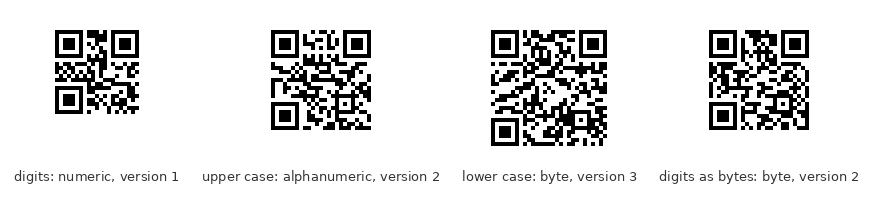 // Sample output:
// digits: mode numeric, version 1
// upper case: mode alphanumeric, version 2
// lower case: mode byte, version 3
// digits as bytes: mode byte, version 2
}