PureBasic
PureBasic
HMRC OAuth2 Access Token
See more OAuth2 Examples
Demonstrates how to get an HMRC OAuth2 access token from a desktop (installed) application or script. This example gets an HMRC MTD VAT read/write access token.Chilkat PureBasic Downloads
IncludeFile "CkFileAccess.pb"
IncludeFile "CkJsonObject.pb"
IncludeFile "CkOAuth2.pb"
IncludeFile "CkDateTime.pb"

Procedure ChilkatExample()

    success.i = 0

    ; To further clarify, see OAuth 2.0 Authorization Flow

    oauth2.i = CkOAuth2::ckCreate()
    If oauth2.i = 0
        Debug "Failed to create object."
        ProcedureReturn
    EndIf

    ; This should be the port in the localhost callback URL for your app.
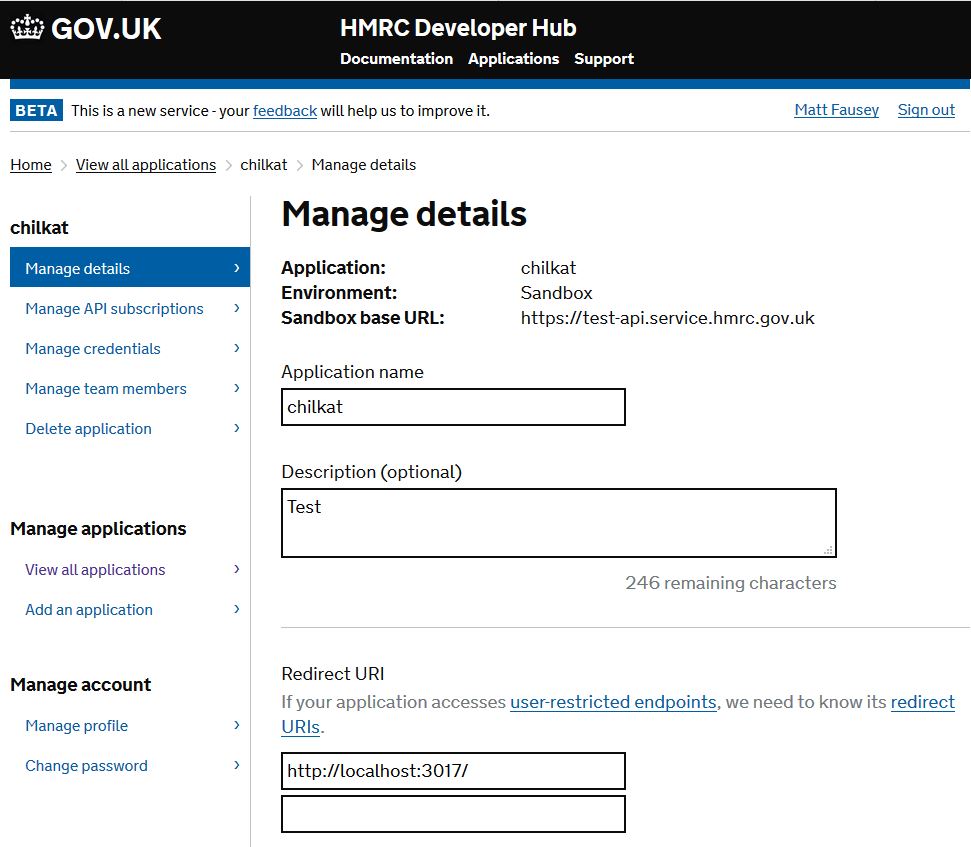
    ; Important: Make sure the callback URI in your HMRC developer app
    ; is exactly "http://localhost:3017/".  Don't forget the ending "/" char.
    ; The callback URL would look like "http://localhost:3017/" if the port number is 3017.

    ; IMPORTANT: Don't forget to setup your HMRC application to use the Redirect URI "http://localhost:3017/" as shown
    ; here: Configure Redirect URI for HMRC application
    CkOAuth2::setCkListenPort(oauth2, 3017)

    CkOAuth2::setCkAuthorizationEndpoint(oauth2, "https://test-api.service.hmrc.gov.uk/oauth/authorize")
    CkOAuth2::setCkTokenEndpoint(oauth2, "https://test-api.service.hmrc.gov.uk/oauth/token")

    ; Replace with your actual client ID
    CkOAuth2::setCkClientId(oauth2, "HMRC-CLIENT-ID")

    ; The scopes are documented in the HMRC reference documentation for each API.
    ; This example gets a read/write access token for the HMRC MTD VAT API.
    CkOAuth2::setCkScope(oauth2, "read:vat write:vat")

    ; Begin the OAuth2 Authorization code flow.  This returns a URL that should be loaded in a browser.
    url.s = CkOAuth2::ckStartAuth(oauth2)
    If CkOAuth2::ckLastMethodSuccess(oauth2) <> 1
        Debug CkOAuth2::ckLastErrorText(oauth2)
        CkOAuth2::ckDispose(oauth2)
        ProcedureReturn
    EndIf

    ; Launch the default browser on the system and navigate to the url.
    ; The LaunchBrowser method was added in Chilkat v10.1.2.
    success = CkOAuth2::ckLaunchBrowser(oauth2,url)
    If success = 0
        Debug CkOAuth2::ckLastErrorText(oauth2)
        CkOAuth2::ckDispose(oauth2)
        ProcedureReturn
    EndIf

    ; Wait for the user to approve or deny authorization in the browser.
    numMsWaited.i = 0
    While (numMsWaited < 90000) AND (CkOAuth2::ckAuthFlowState(oauth2) < 3)
        CkOAuth2::ckSleepMs(oauth2,100)
        numMsWaited = numMsWaited + 100
    Wend

    ; If the browser does not respond within the specified time, AuthFlowState will be:
    ;
    ; 1: Waiting for Redirect – The OAuth2 background thread is waiting for the browser's redirect request.
    ; 2: Waiting for Final Response – The thread is awaiting the final access token response.
    ; In either case, cancel the background task initiated by StartAuth.

    If CkOAuth2::ckAuthFlowState(oauth2) < 3
        CkOAuth2::ckCancel(oauth2)
        Debug "No response from the browser!"
        CkOAuth2::ckDispose(oauth2)
        ProcedureReturn
    EndIf

    ; Check AuthFlowState to determine if authorization was granted, denied, or failed:
    ;
    ; 3: Success – OAuth2 flow completed, the background thread exited, and the successful response is in AccessTokenResponse.
    ; 4: Access Denied – OAuth2 flow completed, the background thread exited, and the error response is in AccessTokenResponse.
    ; 5: Failure – OAuth2 flow failed before completion, the background thread exited, and error details are in FailureInfo.

    If CkOAuth2::ckAuthFlowState(oauth2) = 5
        Debug "OAuth2 failed to complete."
        Debug CkOAuth2::ckFailureInfo(oauth2)
        CkOAuth2::ckDispose(oauth2)
        ProcedureReturn
    EndIf

    If CkOAuth2::ckAuthFlowState(oauth2) = 4
        Debug "OAuth2 authorization was denied."
        Debug CkOAuth2::ckAccessTokenResponse(oauth2)
        CkOAuth2::ckDispose(oauth2)
        ProcedureReturn
    EndIf

    If CkOAuth2::ckAuthFlowState(oauth2) <> 3
        Debug "Unexpected AuthFlowState:" + Str(CkOAuth2::ckAuthFlowState(oauth2))
        CkOAuth2::ckDispose(oauth2)
        ProcedureReturn
    EndIf

    Debug "OAuth2 authorization granted!"
    Debug "Access Token = " + CkOAuth2::ckAccessToken(oauth2)

    ; Get the full JSON response:
    json.i = CkJsonObject::ckCreate()
    If json.i = 0
        Debug "Failed to create object."
        ProcedureReturn
    EndIf

    CkJsonObject::ckLoad(json,CkOAuth2::ckAccessTokenResponse(oauth2))
    CkJsonObject::setCkEmitCompact(json, 0)
    Debug CkJsonObject::ckEmit(json)

    ; The JSON response looks like this:

    ; {
    ;   "token_type": "Bearer",
    ;   "scope": "user_impersonation",
    ;   "expires_in": "3599",
    ;   "ext_expires_in": "0",
    ;   "expires_on": "1524783438",
    ;   "not_before": "1524779538",
    ;   "resource": "https://mydomain.api.crm.dynamics.com",
    ;   "access_token": "...",
    ;   "refresh_token": "...",
    ;   "id_token": "..."
    ; }

    ; If an "expires_on" member does not exist, then add the JSON member by
    ; getting the current system date/time and adding the "expires_in" seconds.
    ; This way we'll know when the token expires.
    If CkJsonObject::ckHasMember(json,"expires_on") <> 1
        dtExpire.i = CkDateTime::ckCreate()
        If dtExpire.i = 0
            Debug "Failed to create object."
            ProcedureReturn
        EndIf

        CkDateTime::ckSetFromCurrentSystemTime(dtExpire)
        CkDateTime::ckAddSeconds(dtExpire,CkJsonObject::ckIntOf(json,"expires_in"))
        CkJsonObject::ckAppendString(json,"expires_on",CkDateTime::ckGetAsUnixTimeStr(dtExpire,0))
    EndIf

    Debug CkJsonObject::ckEmit(json)

    ; Save the JSON to a file for future requests.
    fac.i = CkFileAccess::ckCreate()
    If fac.i = 0
        Debug "Failed to create object."
        ProcedureReturn
    EndIf

    CkFileAccess::ckWriteEntireTextFile(fac,"qa_data/tokens/hmrc.json",CkJsonObject::ckEmit(json),"utf-8",0)


    CkOAuth2::ckDispose(oauth2)
    CkJsonObject::ckDispose(json)
    CkDateTime::ckDispose(dtExpire)
    CkFileAccess::ckDispose(fac)


    ProcedureReturn
EndProcedure