Perl Requires Chilkat v9.5.0.85+
Chilkat2 Perl
PDF Signature with Background Image (Seal/Stamp/etc.)
See more PDF Signatures Examples
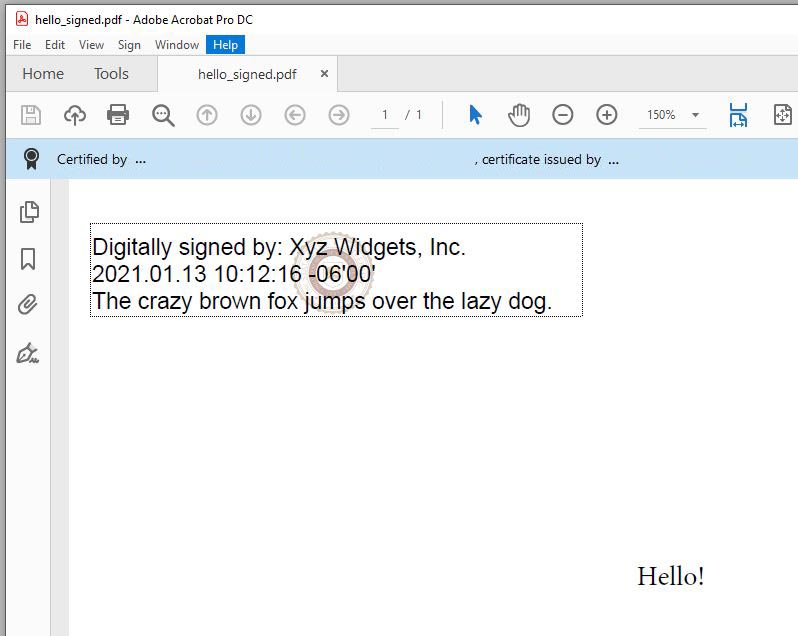
Demonstrates how to sign a PDF with an appearance that includes a background image, such as a seal, stamp, etc.Chilkat Perl Downloads
use strict;
use warnings;
use Chilkat2;

# This example requires the Chilkat API to have been previously unlocked.
# See Global Unlock Sample for sample code.

my $pdf = Chilkat2::Pdf->new;

# Load a PDF to be signed.
# The "hello.pdf" is available at https://chilkatsoft.com/hello.pdf
my $success = $pdf->LoadFile('qa_data/pdf/hello.pdf');
if (!$success) {
    print $pdf->LastErrorText, "\n";
    exit;
}

# Options for signing are specified in JSON.
my $json = Chilkat2::JsonObject->new;

# In most cases, the signingCertificateV2 and signingTime attributes are required.
$json->UpdateInt('signingCertificateV2', 1);
$json->UpdateInt('signingTime', 1);

# Put the signature on page 1, top left
$json->UpdateInt('page', 1);
$json->UpdateString('appearance.y', 'top');
$json->UpdateString('appearance.x', 'left');

# Use a font scale of 10.0
$json->UpdateString('appearance.fontScale', '10.0');

# In this example, the appearance of the digital signature will contain three lines:
# 1) The signing certificate's common name
# 2) The current date/time
# 3) Some arbitrary text.
# The keyword "cert_cn" is replaced with the Certificate's Subject Common Name.
# The keyword "current_dt" is replaced with the current date/time.
# Any number of appearance text lines can be added.
$json->UpdateString('appearance.text[0]', 'Digitally signed by: cert_cn');
$json->UpdateString('appearance.text[1]', 'current_dt');
$json->UpdateString('appearance.text[2]', 'The crazy brown fox jumps over the lazy dog.');

# Load a JPG image to be shown with 30% opacity in the background.
# (the image must be in the JPG format)
# The sample university.jpb is available at https://example-code.com/images/university.jpg

my $jpgData = Chilkat2::BinData->new;
$success = $jpgData->LoadFile('qa_data/jpg/university.jpg');
if (!$success) {
    print "Failed to load the JPG image.\n";
    exit;
}

$success = $pdf->SetSignatureJpeg($jpgData);
if (!$success) {
    print $pdf->LastErrorText, "\n";
    exit;
}

# Specify that we want to display the JPG image in the center with 30% opacity.
$json->UpdateString('appearance.image', 'custom-jpg');
$json->UpdateString('appearance.imagePlacement', 'center');
$json->UpdateString('appearance.imageOpacity', '30');

# Load the signing certificate. (Use your own certificate.)
my $cert = Chilkat2::Cert->new;
$success = $cert->LoadPfxFile('qa_data/pfx/myPdfSigningCert.pfx', 'secret');
if (!$success) {
    print $cert->LastErrorText, "\n";
    exit;
}

# Tell the pdf object to use the certificate for signing.
$success = $pdf->SetSigningCert($cert);
if (!$success) {
    print $pdf->LastErrorText, "\n";
    exit;
}

$success = $pdf->SignPdf($json, 'qa_output/hello_signed.pdf');
if (!$success) {
    print $pdf->LastErrorText, "\n";
    exit;
}

print "The PDF has been successfully cryptographically signed.\n";

# The appearance of the signature appears in Adobe Acrobat as shown below.
# The JPG is automatically scaled to the size of the signature based on the signature's font scale
# and number of text lines.
#