Perl
Perl
Get OAuth2 Access Token for Azure Registered App
Demonstrates how to get OAuth2 access token for an Azure Registered App from a desktop application or script. This example demonstrates the OAuth2 authorization flow.This example requires Chilkat v10.1.2 or greater.
Chilkat Perl Downloads
use chilkat();

$success = 0;

# To further clarify, see OAuth 2.0 Authorization Flow

$oauth2 = chilkat::CkOAuth2->new();

# This should be the port in the localhost callback URL for your app.
# The callback URL would look like "http://localhost:3017/" if the port number is 3017.
$oauth2->put_ListenPort(3017);

# ----------------------------------------------------------------------------------------------------------
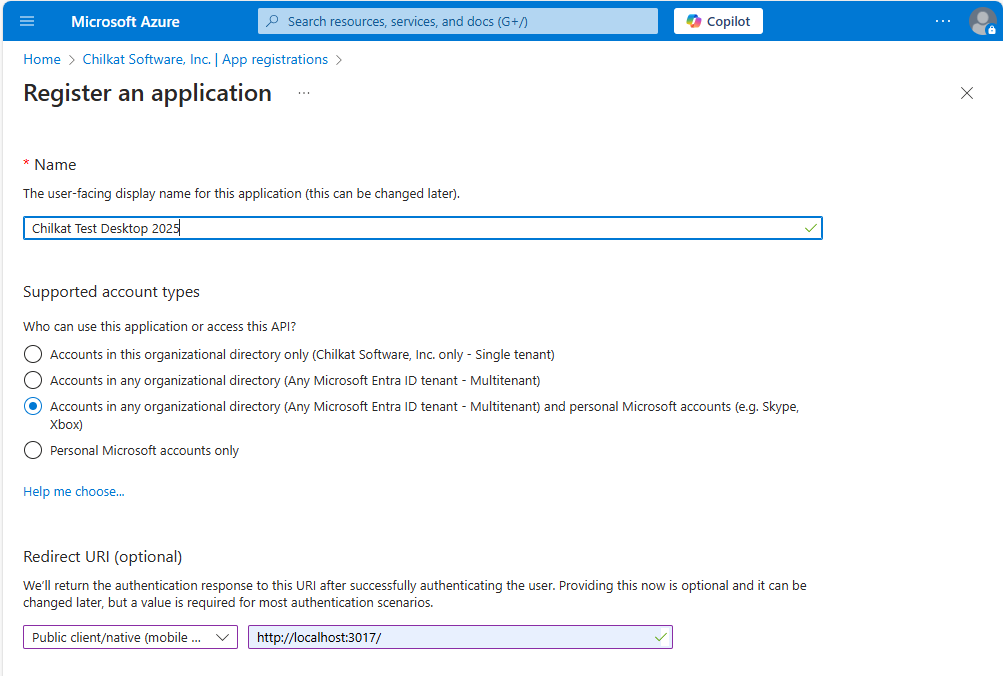
# The screenshot at the bottom of this page shows how we created the Azure App Registration for this example.
# ----------------------------------------------------------------------------------------------------------

# Note: The endpoint depends on the Azure App Registration.
# See How to Choose the Correct Endpoints for your Azure App Registration
$oauth2->put_AuthorizationEndpoint("https://login.microsoftonline.com/common/oauth2/v2.0/authorize");
$oauth2->put_TokenEndpoint("https://login.microsoftonline.com/common/oauth2/v2.0/token");

# Replace these with actual values.
$oauth2->put_ClientId("CLIENT_ID");

# This is for Require Proof Key for Code Exchange (PKCE)
# See OAuth2 PKCE Explained
$oauth2->put_CodeChallenge(1);
$oauth2->put_CodeChallengeMethod("S256");

# Provide a SPACE separated list of scopes.
# See https://developer.microsoft.com/en-us/graph/docs/authorization/permission_scopes

# Important: To get a refresh token in the final response, ask for "offline_access" scope
$oauth2->put_Scope("openid profile offline_access user.readwrite mail.readwrite mail.send files.readwrite");

# Begin the OAuth2 three-legged flow.  This returns a URL that should be loaded in a browser.
$url = $oauth2->startAuth();
if ($oauth2->get_LastMethodSuccess() != 1) {
    print $oauth2->lastErrorText() . "\r\n";
    exit;
}

# Launch the default browser on the system and navigate to the url.
# The LaunchBrowser method was added in Chilkat v10.1.2.
$success = $oauth2->LaunchBrowser($url);
if ($success == 0) {
    print $oauth2->lastErrorText() . "\r\n";
    exit;
}

# Wait for the user to approve or deny authorization in the browser.
$numMsWaited = 0;
while (($numMsWaited < 90000) and ($oauth2->get_AuthFlowState() < 3)) {
    $oauth2->SleepMs(100);
    $numMsWaited = $numMsWaited + 100;
}

# If the browser does not respond within the specified time, AuthFlowState will be:
#
# 1: Waiting for Redirect � The OAuth2 background thread is waiting for the browser's redirect request.
# 2: Waiting for Final Response � The thread is awaiting the final access token response.
# In either case, cancel the background task initiated by StartAuth.

if ($oauth2->get_AuthFlowState() < 3) {
    $oauth2->Cancel();
    print "No response from the browser!" . "\r\n";
    exit;
}

# Check AuthFlowState to determine if authorization was granted, denied, or failed:
#
# 3: Success � OAuth2 flow completed, the background thread exited, and the successful response is in AccessTokenResponse.
# 4: Access Denied � OAuth2 flow completed, the background thread exited, and the error response is in AccessTokenResponse.
# 5: Failure � OAuth2 flow failed before completion, the background thread exited, and error details are in FailureInfo.

if ($oauth2->get_AuthFlowState() == 5) {
    print "OAuth2 failed to complete." . "\r\n";
    print $oauth2->failureInfo() . "\r\n";
    exit;
}

if ($oauth2->get_AuthFlowState() == 4) {
    print "OAuth2 authorization was denied." . "\r\n";
    print $oauth2->accessTokenResponse() . "\r\n";
    exit;
}

if ($oauth2->get_AuthFlowState() != 3) {
    print "Unexpected AuthFlowState:" . $oauth2->get_AuthFlowState() . "\r\n";
    exit;
}

print "OAuth2 authorization granted!" . "\r\n";
print "Access Token = " . $oauth2->accessToken() . "\r\n";

# When the token is near expiration, your app can refresh as shown here:
# Refresh Expiring OAuth2 Access Token for Azure Registered App

# Get the full JSON response:
$json = chilkat::CkJsonObject->new();
$json->Load($oauth2->accessTokenResponse());
$json->put_EmitCompact(0);

# The JSON response looks like this:

# {
#   "token_type": "Bearer",
#   "scope": "User.Read Mail.ReadWrite Mail.Send",
#   "expires_in": 3600,
#   "ext_expires_in": 0,
#   "access_token": "EwBAA8l6B...",
#   "refresh_token": "MCRMdbe...",
#   "id_token": "eyJ0eXA..."
# }

# If an "expires_on" member does not exist, then add the JSON member by
# getting the current system date/time and adding the "expires_in" seconds.
# This way we'll know when the token expires.
if ($json->HasMember("expires_on") != 1) {
    $dtExpire = chilkat::CkDateTime->new();
    $dtExpire->SetFromCurrentSystemTime();
    $dtExpire->AddSeconds($json->IntOf("expires_in"));
    $json->AppendString("expires_on",$dtExpire->getAsUnixTimeStr(0));
}

print $json->emit() . "\r\n";

# Save the JSON to a file for future requests.
$fac = chilkat::CkFileAccess->new();
$fac->WriteEntireTextFile("qa_data/tokens/_myAzureApp.json",$json->emit(),"utf-8",0);

# This is a screenshot of how we created the Azure App for this example:
#