Lazarus Pascal
 Lazarus Pascal
Demonstrates the ChilkatPath XML Method
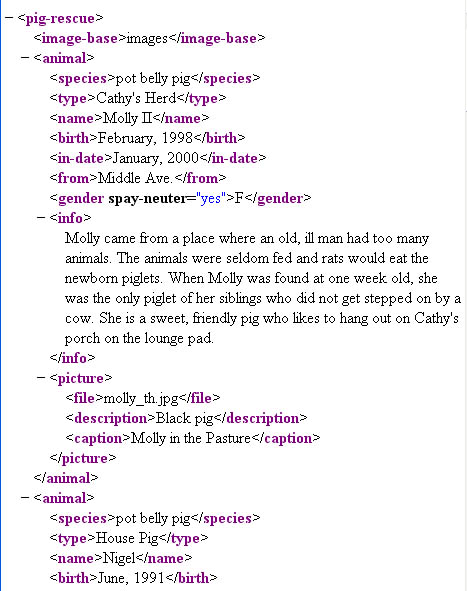
Demonstrates how to use the ChilkatPath method. This example uses the XML sample file pigs.xml. The pigs.xml file contains this content:
Chilkat Lazarus Pascal Downloads
program ChilkatDemo;
// Demonstrates using the Chilkat Pascal wrapper via the C bridge DLL.
// Builds as a console application under Lazarus (FPC) or Delphi.
{$IFDEF FPC}
{$MODE DELPHI}
{$ENDIF}
{$APPTYPE CONSOLE}
uses
{$IFDEF UNIX}
cthreads,
{$ENDIF}
SysUtils,
CkDllLoader,
Chilkat.Xml;
// ---------------------------------------------------------------------------
procedure RunDemo;
var
success: Boolean;
xml: TXml;
result: string;
begin
success := False;
xml := TXml.Create;
success := xml.LoadXmlFile('qa_data/xml/pigs.xml');
if (success <> True) then
begin
WriteLn(xml.LastErrorText);
Exit;
end;
// Get the content of the "species" node for the 1st animal:
result := xml.ChilkatPath('animal|species|*');
// Output should be "pot belly pig"
WriteLn(result);
// Get the content of the "type" node for the 2nd animal:
// Indexing begins at 0. Therefore, the 2nd direct child having
// the tag "animal" is at index 1
result := xml.ChilkatPath('animal[1]|type|*');
// Output should be "House Pig"
WriteLn(result);
// Find the pig having the name "Nigel" and display the
// birth date. To do this, we'll navigate to the node having
// tag="name" with the exact content "Nigel", then navigate up,
// and finally navigate back down to the "birth" node:
result := xml.ChilkatPath('/C/name,Nigel|..|birth|*');
// Output should be "June, 1991"
WriteLn(result);
// Navigate to the 1st animal's picture and print the filename,
// description, and caption.
// The "$" updates the caller's internal pointer to reference
// the node that is the result of evaluating the path.
// An empty string is returned for success, and a NULL/nil/0
// pointer (reference) is returned on failure.
result := xml.ChilkatPath('animal|picture|$');
if (xml.LastMethodSuccess <> True) then
begin
WriteLn('Failed to navigate to animal|picture.');
Exit;
end;
// Display the contents of the file/description/caption child nodes
WriteLn('Picture Info:');
WriteLn(xml.GetChildContent('file'));
WriteLn(xml.GetChildContent('description'));
WriteLn(xml.GetChildContent('caption'));
// Return back to the root of the XML document:
xml.GetRoot2();
// Display the value of the "spay-neuter" attribute of the 1st animal:
WriteLn('----');
result := xml.ChilkatPath('animal|gender|(spay-neuter)');
WriteLn(result);
xml.Free;
end;
// ---------------------------------------------------------------------------
begin
try
RunDemo;
except
on E: Exception do
WriteLn('Unhandled exception: ', E.ClassName, ': ', E.Message);
end;
WriteLn;
{$IFDEF MSWINDOWS}
WriteLn('Press Enter to exit...');
ReadLn;
{$ENDIF}
end.