Lazarus Pascal
Lazarus Pascal
Doppler Secrets - Create or Update a Secret
See more Secrets Examples
Demonstrates how to create or update a secret stored in the Doppler Secrets.Note: This example requires Chilkat v10.1.0 or later.
Chilkat Lazarus Pascal Downloads
program ChilkatDemo;
// Demonstrates using the Chilkat Pascal wrapper via the C bridge DLL.
// Builds as a console application under Lazarus (FPC) or Delphi.
{$IFDEF FPC}
{$MODE DELPHI}
{$ENDIF}
{$APPTYPE CONSOLE}
uses
{$IFDEF UNIX}
cthreads,
{$ENDIF}
SysUtils,
CkDllLoader,
Chilkat.Secrets,
Chilkat.JsonObject;
// ---------------------------------------------------------------------------
procedure RunDemo;
var
success: Boolean;
bootstrap: TSecrets;
bsId: TJsonObject;
secrets: TSecrets;
json: TJsonObject;
begin
success := False;
// This example requires the Chilkat API to have been previously unlocked.
// See Global Unlock Sample for sample code.
// The bootstrap secret will contain the following information:
// Doppler Token
// See following examples for setting up a bootstrap secret in memory,
// or in the local manager (Windows Credentials Manager or Apple Keychain)
// Setup Bootstrap Secret in Local Manager
// Setup Bootstrap Secret in Memory
bootstrap := TSecrets.Create;
// Set the location of the bootstrap secret.
// Can be "local_manager" or "memory", depending on how you setup the bootstrap secret.
// ---------------------------------------------------------------------------------------------
// If your operating system is NOT Windows or MacOS/iOS, then change "local_manager" to "memory"
// You can also, if desired, use "memory" on Windows and MacOS/iOS if your bootstrap secret was previously setup in memory.
// ---------------------------------------------------------------------------------------------
bootstrap.Location := 'local_manager';
// Specify the bootstrap secret to be used.
bsId := TJsonObject.Create;
bsId.UpdateString('appName','doppler_bs');
bsId.UpdateString('service','Example');
bsId.UpdateString('username','Joe');
// ----------------------------------------------------
secrets := TSecrets.Create;
// Setup for the Doppler Secrets
secrets.Location := 'doppler';
success := secrets.SetBootstrapSecret(bsId,bootstrap);
if (success = False) then
begin
WriteLn(secrets.LastErrorText);
Exit;
end;
// Let's create or update a secret in the Doppler Secrets.
// (The secret is updated if it already exists.)
json := TJsonObject.Create;
json.UpdateString('appName','Test');
json.UpdateString('service','Something');
json.UpdateString('domain','Xyz');
json.UpdateString('username','Abc');
// You'll also need to specify your Doppler project and config names for each API call.
json.UpdateString('project_name','example-project');
json.UpdateString('config_name','dev');
// Create or update the secret.
success := secrets.UpdateSecretStr(json,'This is the secret.');
if (success = False) then
begin
WriteLn(secrets.LastErrorText);
Exit;
end;
WriteLn('Success.');
// Here you can see the secret that was created:
// 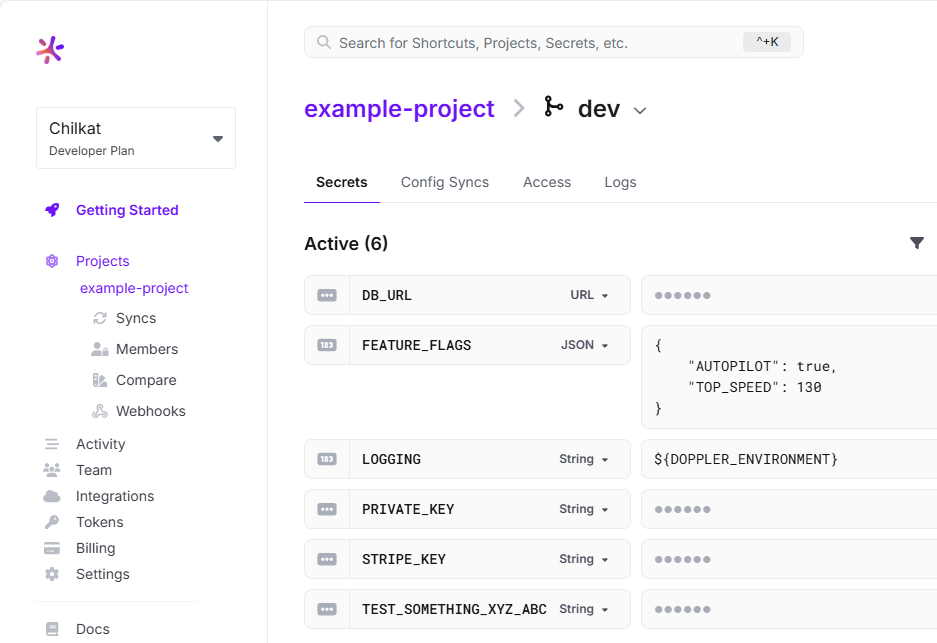 bootstrap.Free;
bsId.Free;
secrets.Free;
json.Free;
end;
// ---------------------------------------------------------------------------
begin
try
RunDemo;
except
on E: Exception do
WriteLn('Unhandled exception: ', E.ClassName, ': ', E.Message);
end;
WriteLn;
{$IFDEF MSWINDOWS}
WriteLn('Press Enter to exit...');
ReadLn;
{$ENDIF}
end.
bootstrap.Free;
bsId.Free;
secrets.Free;
json.Free;
end;
// ---------------------------------------------------------------------------
begin
try
RunDemo;
except
on E: Exception do
WriteLn('Unhandled exception: ', E.ClassName, ': ', E.Message);
end;
WriteLn;
{$IFDEF MSWINDOWS}
WriteLn('Press Enter to exit...');
ReadLn;
{$ENDIF}
end.