Go Requires Chilkat v11.7.0+
Go
QR Code Error Correction Levels
See more QR Code Examples
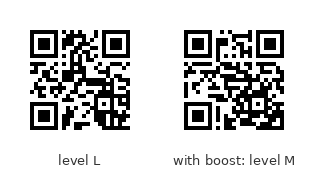
Demonstrates the four QR error-correction levels. L, M, Q and H allow a reader to recover the data when about 7%, 15%, 25% and 30% of the symbol is damaged or covered. More error correction leaves less room for data, so the same text needs a larger symbol at a higher level. The default is M. The example also shows boostErrorCorrection, which raises the level for free when the chosen version has room to spare.Chilkat Go Downloads
success := false
// This example requires the Chilkat API to have been previously unlocked.
// See Global Unlock Sample for sample code.
fmt := chilkat.NewFormats()
json := chilkat.NewJsonObject()
jsonOut := chilkat.NewJsonObject()
json.UpdateString("payload.text","https://www.chilkatsoft.com/barcode_overview.asp")
// Encode the same text at each level.
levels := chilkat.NewJsonArray()
levels.Load("[\"L\",\"M\",\"Q\",\"H\"]")
var i int
for i = 0; i <= 3; i++ {
json.UpdateString("encoding.qr.errorCorrection",*levels.StringAt(i))
success = fmt.QrCode("generate",json,jsonOut)
if success == false {
fmt.Println(fmt.LastErrorText())
fmt.DisposeFormats()
json.DisposeJsonObject()
jsonOut.DisposeJsonObject()
levels.DisposeJsonArray()
return
}
fmt.Println("level ", *levels.StringAt(i), ": version ", jsonOut.IntOf("symbols[0].selectedEncoding.version"), ", ", jsonOut.IntOf("symbols[0].dimensions.modulesWide")
, " modules wide")
}
// The four symbols. They hold the same text, and the higher the level, the larger the symbol:
// 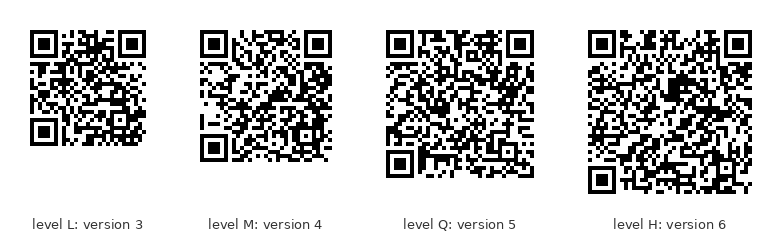 // A symbol often has room left over. boostErrorCorrection uses it: the level is raised
// as far as the same version allows, so the symbol is no larger but is more robust.
json2 := chilkat.NewJsonObject()
json2.UpdateString("payload.text","https://chilkatsoft.com")
json2.UpdateString("encoding.qr.errorCorrection","L")
success = fmt.QrCode("generate",json2,jsonOut)
if success == false {
fmt.Println(fmt.LastErrorText())
fmt.DisposeFormats()
json.DisposeJsonObject()
jsonOut.DisposeJsonObject()
levels.DisposeJsonArray()
json2.DisposeJsonObject()
return
}
fmt.Println("level L requested: version ", jsonOut.IntOf("symbols[0].selectedEncoding.version"), ", level ", *jsonOut.StringOf("symbols[0].selectedEncoding.errorCorrection"))
json2.UpdateBool("encoding.qr.boostErrorCorrection",true)
success = fmt.QrCode("generate",json2,jsonOut)
if success == false {
fmt.Println(fmt.LastErrorText())
fmt.DisposeFormats()
json.DisposeJsonObject()
jsonOut.DisposeJsonObject()
levels.DisposeJsonArray()
json2.DisposeJsonObject()
return
}
fmt.Println("level L with boost: version ", jsonOut.IntOf("symbols[0].selectedEncoding.version"), ", level ", *jsonOut.StringOf("symbols[0].selectedEncoding.errorCorrection"))
// Level L, and level M reached by the boost. The two symbols are the same size:
//
 // Sample output:
// level L: version 3, 29 modules wide
// level M: version 4, 33 modules wide
// level Q: version 5, 37 modules wide
// level H: version 6, 41 modules wide
// level L requested: version 2, level L
// level L with boost: version 2, level M
fmt.DisposeFormats()
json.DisposeJsonObject()
jsonOut.DisposeJsonObject()
levels.DisposeJsonArray()
json2.DisposeJsonObject()