Android™
 Android™
Demonstrates the ChilkatPath XML Method
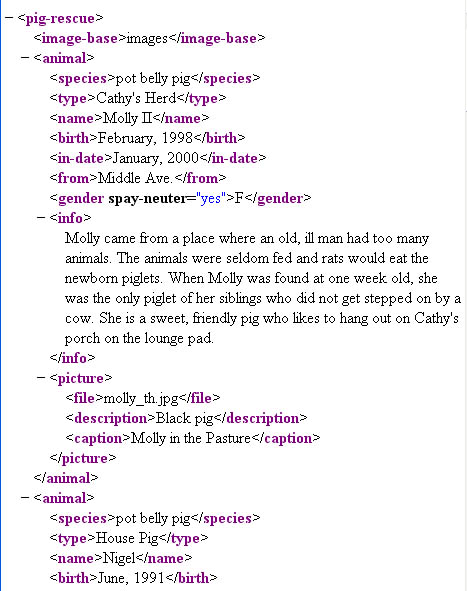
Demonstrates how to use the ChilkatPath method. This example uses the XML sample file pigs.xml. The pigs.xml file contains this content:
Chilkat Android™ Downloads
// Important: Don't forget to include the call to System.loadLibrary
// as shown at the bottom of this code sample.
package com.test;

import android.app.Activity;
import com.chilkatsoft.*;

import android.widget.TextView;
import android.os.Bundle;

public class SimpleActivity extends Activity {

  private static final String TAG = "Chilkat";

  // Called when the activity is first created.
  @Override
  public void onCreate(Bundle savedInstanceState) {
    super.onCreate(savedInstanceState);

    boolean success = false;

    CkXml xml = new CkXml();

    success = xml.LoadXmlFile("qa_data/xml/pigs.xml");
    if (success != true) {
        Log.i(TAG, xml.lastErrorText());
        return;
        }

    //  Get the content of the "species" node for the 1st animal:
    String result;
    result = xml.chilkatPath("animal|species|*");
    //  Output should be "pot belly pig"
    Log.i(TAG, result);

    //  Get the content of the "type" node for the 2nd animal:
    //  Indexing begins at 0.  Therefore, the 2nd direct child having
    //  the tag "animal" is at index 1
    result = xml.chilkatPath("animal[1]|type|*");
    //  Output should be "House Pig"
    Log.i(TAG, result);

    //  Find the pig having the name "Nigel" and display the
    //  birth date.  To do this, we'll navigate to the node having
    //  tag="name" with the exact content "Nigel", then navigate up,
    //  and finally navigate back down to the "birth" node:
    result = xml.chilkatPath("/C/name,Nigel|..|birth|*");
    //  Output should be "June, 1991"
    Log.i(TAG, result);

    //  Navigate to the 1st animal's picture and print the filename,
    //  description, and caption.
    //  The "$" updates the caller's internal pointer to reference
    //  the node that is the result of evaluating the path.
    //  An empty string is returned for success, and a NULL/nil/0
    //  pointer (reference) is returned on failure.
    result = xml.chilkatPath("animal|picture|$");
    if (xml.get_LastMethodSuccess() != true) {
        Log.i(TAG, "Failed to navigate to animal|picture.");
        return;
        }

    //  Display the contents of the file/description/caption child nodes
    Log.i(TAG, "Picture Info:");
    Log.i(TAG, xml.getChildContent("file"));
    Log.i(TAG, xml.getChildContent("description"));
    Log.i(TAG, xml.getChildContent("caption"));

    //  Return back to the root of the XML document:
    xml.GetRoot2();

    //  Display the value of the "spay-neuter" attribute of the 1st animal:
    Log.i(TAG, "----");
    result = xml.chilkatPath("animal|gender|(spay-neuter)");
    Log.i(TAG, result);

  }

  static {
      System.loadLibrary("chilkat");

      // Note: If the incorrect library name is passed to System.loadLibrary,
      // then you will see the following error message at application startup:
      //"The application <your-application-name> has stopped unexpectedly. Please try again."
  }
}