Java Requires Chilkat v11.0.0+
Java
ETrade OAuth1 Authorization (3-legged) Step 1
See more ETrade Examples
Demonstrates the first step in 3-legged OAuth1 authorization for the ETrade REST API. This example sends an HTTP request to the "request token URL" to get a request token that begins the OAuth1 process. (See https://apisb.etrade.com/docs/api/authorization/request_token.html )This example uses the sandbox request token URL. The live request token URL would be "https://api.etrade.com/oauth/request_token".
Chilkat Java Downloads
import com.chilkatsoft.*;
public class ChilkatExample {
static {
try {
System.loadLibrary("chilkat");
} catch (UnsatisfiedLinkError e) {
System.err.println("Native code library failed to load.\n" + e);
System.exit(1);
}
}
public static void main(String argv[])
{
boolean success = false;
// This requires the Chilkat API to have been previously unlocked.
// See Global Unlock Sample for sample code.
String consumerKey = "ETRADE_CONSUMER_KEY";
String consumerSecret = "ETRADE_CONSUMER_SECRET";
// Note: This example uses the sandbox request token URL.
// The live Get Request Token Request URL is:
// https://api.etrade.com/oauth/request_token
// This example will use the Sandbox Token Request URL:
String requestTokenUrl = "https://apisb.etrade.com/oauth/request_token";
CkHttp http = new CkHttp();
success = true;
http.put_OAuth1(true);
http.put_OAuthConsumerKey(consumerKey);
http.put_OAuthConsumerSecret(consumerSecret);
http.put_OAuthCallback("oob");
CkHttpResponse resp = new CkHttpResponse();
success = http.HttpNoBody("GET",requestTokenUrl,resp);
if (success == false) {
System.out.println(http.lastErrorText());
return;
}
// If successful, the resp.BodyStr contains something like this:
// oauth_token=-Wa_KwAAAAAAxfEPAAABV8Qar4Q&oauth_token_secret=OfHY4tZBX2HK4f7yIw76WYdvnl99MVGB&oauth_callback_confirmed=true
System.out.println(resp.bodyStr());
CkHashtable hashTab = new CkHashtable();
hashTab.AddQueryParams(resp.bodyStr());
String requestToken = hashTab.lookupStr("oauth_token");
String requestTokenSecret = hashTab.lookupStr("oauth_token_secret");
http.put_OAuthTokenSecret(requestTokenSecret);
System.out.println("oauth_token = " + requestToken);
System.out.println("oauth_token_secret = " + requestTokenSecret);
// Save this request token for the next step..
CkJsonObject json = new CkJsonObject();
json.AppendString("oauth_token",requestToken);
json.AppendString("oauth_token_secret",requestTokenSecret);
CkFileAccess fac = new CkFileAccess();
fac.WriteEntireTextFile("qa_data/tokens/etrade_request_token.json",json.emit(),"utf-8",false);
// ---------------------------------------------------------------------------
// The next step is to form a URL to send to the authorizeUrl
// This is an HTTP GET that we load into a popup browser.
String authorizeUrl = "https://us.etrade.com/e/t/etws/authorize";
CkStringBuilder sbUrlForBrowser = new CkStringBuilder();
sbUrlForBrowser.Append(authorizeUrl);
sbUrlForBrowser.Append("?key=");
sbUrlForBrowser.Append(consumerKey);
sbUrlForBrowser.Append("&token=");
sbUrlForBrowser.Append(requestToken);
String url = sbUrlForBrowser.getAsString();
// Launch the system's default browser navigated to the URL.
CkOAuth2 oauth2 = new CkOAuth2();
success = oauth2.LaunchBrowser(url);
if (success == false) {
System.out.println(oauth2.lastErrorText());
return;
}
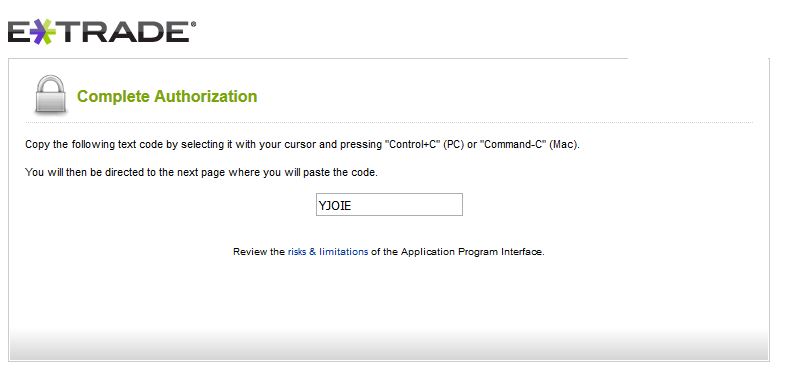
// The ETrade account owner will login and grant access to the application.
// A short verifier code will be displayed (as shown below), and this must be copy-and-pasted
// into the next step to Complete the 3-legged OAuth1 Authorization
// Note: The browser will NOT automatically direct you to the next page.
// You should copy the verifier code, close the browser, and then paste the verifier
// code into your application.
//  }
}
}
}