|
Chilkat • HOME • .NET Core C# • Android™ • AutoIt • C • C# • C++ • Chilkat2-Python • CkPython • Classic ASP • DataFlex • Delphi ActiveX • Delphi DLL • Go • Java • Lianja • Mono C# • Node.js • Objective-C • PHP ActiveX • PHP Extension • Perl • PowerBuilder • PowerShell • PureBasic • Ruby • SQL Server • Swift 2 • Swift 3,4,5... • Tcl • Unicode C • Unicode C++ • VB.NET • VBScript • Visual Basic 6.0 • Visual FoxPro • Xojo Plugin
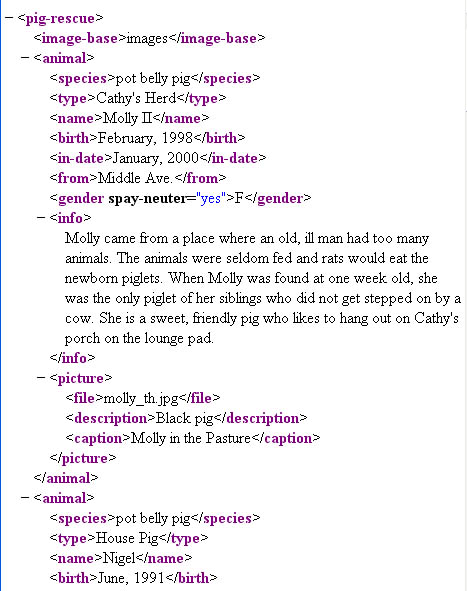
(Classic ASP) Demonstrates the ChilkatPath XML MethodDemonstrates how to use the ChilkatPath method. This example uses the XML sample file pigs.xml. The pigs.xml file contains this content:
<html> <head> <meta http-equiv="Content-Type" content="text/html; charset=utf-8"> </head> <body> <% set xml = Server.CreateObject("Chilkat_9_5_0.Xml") success = xml.LoadXmlFile("qa_data/xml/pigs.xml") If (success <> 1) Then Response.Write "<pre>" & Server.HTMLEncode( xml.LastErrorText) & "</pre>" Response.End End If ' Get the content of the "species" node for the 1st animal: result = xml.ChilkatPath("animal|species|*") ' Output should be "pot belly pig" Response.Write "<pre>" & Server.HTMLEncode( result) & "</pre>" ' Get the content of the "type" node for the 2nd animal: ' Indexing begins at 0. Therefore, the 2nd direct child having ' the tag "animal" is at index 1 result = xml.ChilkatPath("animal[1]|type|*") ' Output should be "House Pig" Response.Write "<pre>" & Server.HTMLEncode( result) & "</pre>" ' Find the pig having the name "Nigel" and display the ' birth date. To do this, we'll navigate to the node having ' tag="name" with the exact content "Nigel", then navigate up, ' and finally navigate back down to the "birth" node: result = xml.ChilkatPath("/C/name,Nigel|..|birth|*") ' Output should be "June, 1991" Response.Write "<pre>" & Server.HTMLEncode( result) & "</pre>" ' Navigate to the 1st animal's picture and print the filename, ' description, and caption. ' The "$" updates the caller's internal pointer to reference ' the node that is the result of evaluating the path. ' An empty string is returned for success, and a NULL/nil/0 ' pointer (reference) is returned on failure. result = xml.ChilkatPath("animal|picture|$") If (xml.LastMethodSuccess <> 1) Then Response.Write "<pre>" & Server.HTMLEncode( "Failed to navigate to animal|picture.") & "</pre>" Response.End End If ' Display the contents of the file/description/caption child nodes Response.Write "<pre>" & Server.HTMLEncode( "Picture Info:") & "</pre>" Response.Write "<pre>" & Server.HTMLEncode( xml.GetChildContent("file")) & "</pre>" Response.Write "<pre>" & Server.HTMLEncode( xml.GetChildContent("description")) & "</pre>" Response.Write "<pre>" & Server.HTMLEncode( xml.GetChildContent("caption")) & "</pre>" ' Return back to the root of the XML document: xml.GetRoot2 ' Display the value of the "spay-neuter" attribute of the 1st animal: Response.Write "<pre>" & Server.HTMLEncode( "----") & "</pre>" result = xml.ChilkatPath("animal|gender|(spay-neuter)") Response.Write "<pre>" & Server.HTMLEncode( result) & "</pre>" %> </body> </html> |
||||
© 2000-2024 Chilkat Software, Inc. All Rights Reserved.